Supervisor, District 1: Connie Chan
 Back to supervisor map
 Back to supervisor map
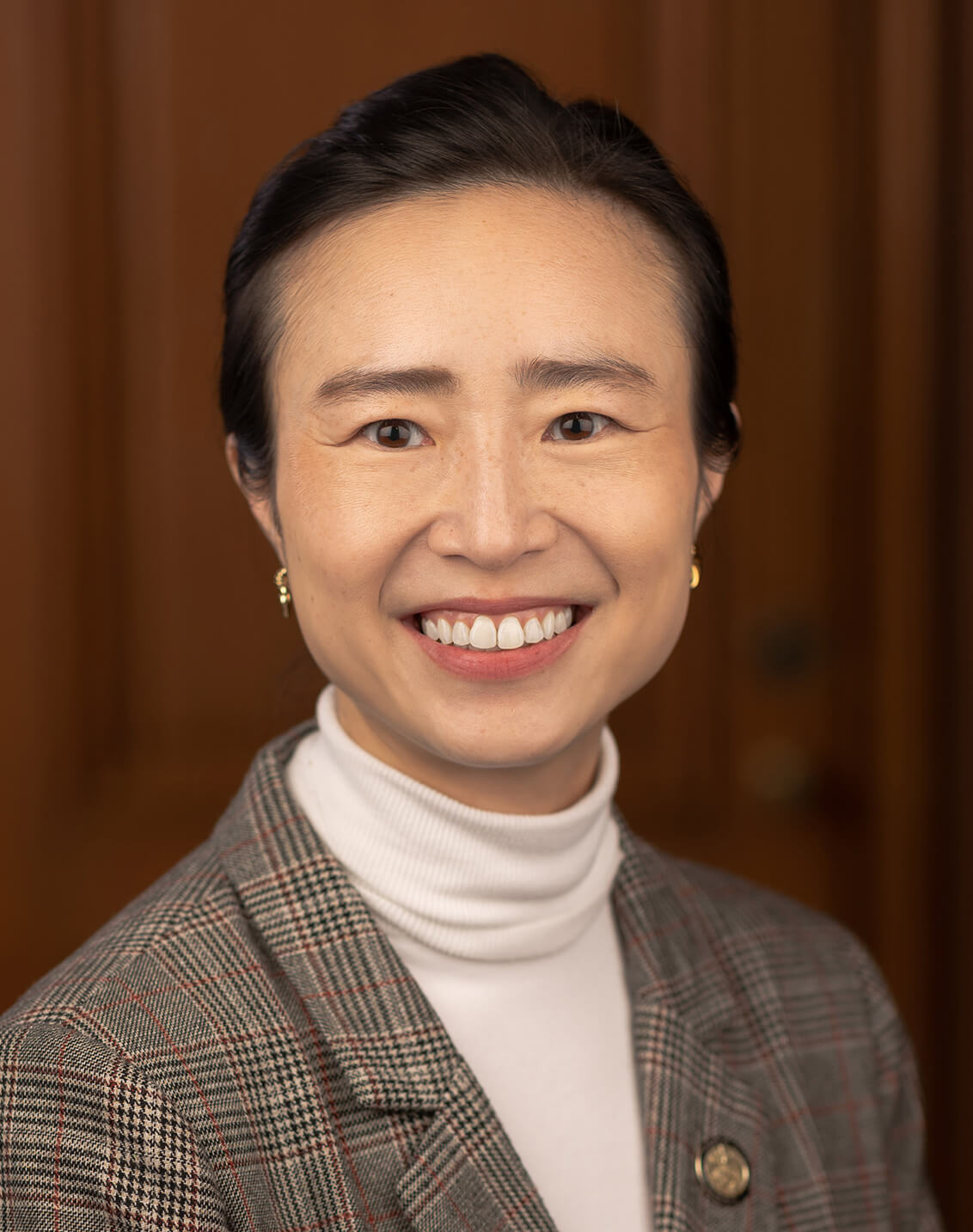
Connie Chan
District 1 Supervisor
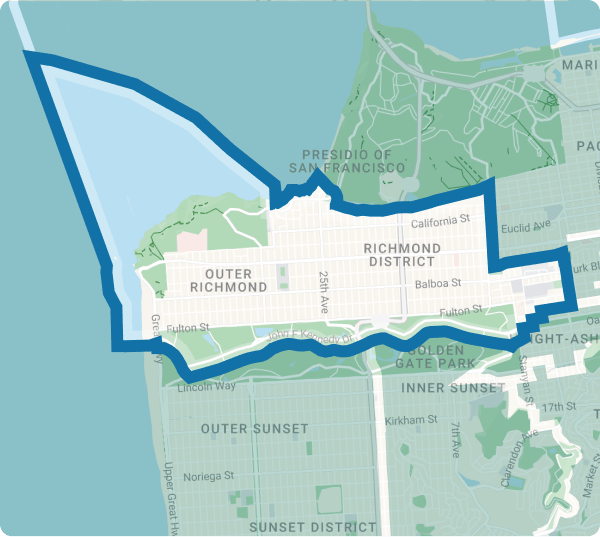
District 1 includes Inner Richmond, Central Richmond, Outer Richmond, Vista del Mar, Seacliff, Lake District, Presidio Terrace, Lone Mountain, Golden Gate Park, Lincoln Park, and the University of San Francisco.
Elected
November 2020
Won by 125 votes.
Re-elected
November 2024
Won by 1,301 votes
Up for Re-Election
Termed out in 2028


Connie Chan is the Supervisor for San Francisco's District 1.
Sign up for GrowSF's weekly roundup of important SF news!
Policy positions & priorities
Supervisor Chan has stated that she would like to see changes in small business support, accountability in city governance, homelessness, transit, support for working families and energy infrastructure. In practice, Chan has been a member of the Board’s progressive bloc and a key opponent of new housing development and transportation reform. She has repeatedly introduced legislation designed to obstruct meaningful change in these areas, including her solo stand against all possible political compromise during the car-free JFK campaign. In 2025, Chan announced that she would run for Congress, seeking to replace Congresswoman Nancy Pelosi’s vacant seat.
Housing
District 1 has the largest shortage of affordable housing in the city. Supervisor Chan’s solution is to push for “100% affordable housing in our new housing development,” which would require developers to lose money on anything they build. In practice, this means that she opposes nearly all new development. This has resulted in a string of votes blocking much-needed new housing and the introduction of legislation, notably Prop E, designed to impede any attempt to streamline development. Chan has rather proudly (and openly) stated that she is following in Aaron Peskin’s footsteps. She voted against Mayor Lurie’s Family Zoning Plan, while also trying to sink with a series of amendments to defang the whole proposal should it pass (like, excluding all historical buildings or all existing residential uses).
For example, within her own district, Chan has rejected developer proposals to create new housing at the Alexandria Theatre, at one point threatening to landmark the property for historic preservation. The slowly deteriorating property, which has sat vacant since 2004, was finally approved for development in 2025. On the other side of the city, Chan voted against the construction of 495 units of new housing at 469 Stevenson Street in SOMA, a decision that sparked widespread outrage and triggered city-level investigations and state intervention.
In 2025, Chan tried to block the removal of the North Beach Special Exemption district, which is particularly notable because the board almost always defers to the supervisor whose district the development is in (but not Connie)! And, finally, here is her fact-challenge response opposing the Marina Safeway redevelopment project.
Transportation
Supervisor Chan has been a key opponent of attempts to provide car-free spaces for pedestrians and bicyclists. Chan’s district includes portions of Golden Gate Park, so she has been a central figure in the car-free JFK debates, if a somewhat bewildering one. JFK Drive was one of the most dangerous streets in San Francisco before Mayor London Breed temporarily closed the eastern span to provide more space for physical distancing and outdoor recreation during the COVID-19 pandemic. As pandemic restrictions began to lift, political and public consensus began to emerge around keeping the eastern span of JFK Drive closed to vehicular traffic. Keeping JFK car-free was overwhelmingly popular with San Franciscans, with 70% of SF Parks and Rec survey respondents in support, but the proposal was bitterly opposed by the De Young Museum–and by Supervisor Chan. She ultimately introduced not one, but two alternative proposals, managing to confuse (and frustrate) nearly everyone involved by backtracking on how much of JFK Drive to close while also flatly refusing to compromise. Unsurprisingly, she voted against the Board of Supervisors resolution to keep JFK car-free, alongside Supervisors Shamann Walton, Ahsha Safaí and Aaron Peskin. The issue was finally settled at the ballot box in November of 2022, with 63.5% of voters choosing to keep car-free JFK.
Supervisor Chan has also consistently supported the re-opening of Great Highway to cars on weekends. She was one of only two supervisors to vote against extending the weekend closures until 2025. In the wake of Upper Great Highway’s closure in March of 2025 and Supervisor Joel Engardio’s subsequent recall, Chan has announced that she will “explore a ballot measure” to re-open Upper Great Highway on weekdays.
When it comes to public transit, Chan cites accessibility as a top concern. She voted in favor of a “Free MUNI” pilot program in 2021 aimed at restoring MUNI ridership levels, which plummeted during the pandemic. The proposal was opposed by MUNI agency leaders already caught between a looming budget deficit and their struggle to restore full service. Research suggests that a free MUNI pilot program would be largely ineffective without a stronger recovery in the downtown area. The measure was ultimately vetoed by Mayor Breed. Chan has generally been supportive of ballot measures to fund transportation infrastructure, including the $400million general obligation bond for SF transportation infrastructure projects and 2024’s Prop L, a proposed tax on ridesharing intended to fund MUNI.
Support for Small Businesses
Chan’s original campaign included a commitment to reducing the “incredible amount of bureaucracy” experienced by local merchants, but in practice, she hasn’t done a whole lot. She voted against letting small businesses close their parklets overnight, increasing the burden on small business owners trying to survive the pandemic and opposed Mayor Breed’s plan to attract business downtown through tax breaks. Chan did support Mayor Breed’s 2023 Small Business Reform package, which eased permitting requirements for ground floor businesses, bars, entertainment establishments and restaurants. In 2025, however, she introduced legislation ostensibly to protect legacy business, by requiring conditional use permits for any business coming in to replace them. She then walked back the whole package when the Small Business Commission noted that these policies would largely be ineffective and, in fact, increase the burden for small business owners.
School Board Reform
In 2022, 72% of voters chose to recall three incompetent school board members–a move opposed by Connie Chan. Voters were angry over the school board’s failure to prioritize school re-openings during the pandemic; its decision to end merit-based admissions at San Francisco’s top high school; its ill-timed and comically flawed school renaming effort; and a trail of embarrassing behavior by board member Alison Collins. But Supervisor Chan opposed the recall effort, citing a general opposition to all recalls. And after the mayor appointed far better board members to replace the recalled officials, Chan called for new appointee Ann Hsu to resign over remarks characterizing a lack of family support and stability as one reason for the underperformance of “marginalized students especially in the black and brown community.”
Fun
Where but in San Francisco would we spend three months debating the extension of a ferris wheel contract, in the midst of a raging pandemic that threatened entire livelihoods, swatches of business and, oh right, the actual loss of human life? Despite approval from two separate city committees to extend the installation of a ferris wheel in Golden Gate Park for an additional four years so that SF families and visitors can have fun, Supervisors Chan and Aaron Peskin dragged the contract before the full Board of Supervisors under the pretense that the ferris wheel, a temporary installation, was in fact a “permanent structure.” Chan and other members of the board’s progressive bloc voted to overrule the four year extension, but ultimately lost the vote.
Key votes and actions
Housing
- Supervisor Chan was a key force in rejecting Mayor London Breed’s attempt to streamline the city’s byzantine housing development process.
- Chan first refused to advance Mayor Breed’s charter amendment out of committee and then, when the issue finally reached the ballot (as Prop D), introduced a competing amendment, Prop E, which she misleadingly titled “the Affordable Housing Production Act.”
- The SF Chronicle described Supervisor Chan’s ballot initiative as “cheap political theater,” noting that the bill manages to be “both redundant and a step backward.”
- SPUR called the bill “a measure that was designed to block the passage of Prop D,” concluding that the new measure “would do nothing to significantly improve the approvals process for housing projects in San Francisco.”
- The move succeeded in blocking Prop D, with both propositions failing at the ballot box.
- Supervisor Chan voted to block the construction of 495 units of family-sized housing on a parcel at 469 Stevenson St. in the SOMA neighborhood. 100 of those units would have been affordable, including for families making only 55% of the area’s median income.
- The vote has been called the city’s “peak NIMBY moment,” in part because it blocked the project by rejecting an environmental report––despite the building site being a Nordstrom valet parking lot, where it would have no negative impact.
- The vote is also cited as an example of undue influence, because opposition to the project was led by a landlord called TODCO that spends millions on political lobbying and political campaigns while failing its low-income tenants, and profits by keeping housing supply low (which drives rents up).
- The vote triggered an investigation from the city’s ethics department.
- The vote also triggered an investigation of impropriety at the state level, followed more recently by intervention from Governor Gavin Newsom.
- Supervisor Chan voted against Mayor Lurie’s Family Zoning Plan, calling it a “monstrosity”. She attempted to significantly reduce the number of eligible properties at the very last minute, with a proposal to exempt all sites with “existing residential uses” from the upzoning.
Transit
- During the Car-Free JFK debates, Chan introduced a new plan to compete with the three plans being systematically evaluated by the Parks Department.
- Chan’s proposal would have re-opened 8th Avenue to traffic, creating a complicated break in the car-free JFK span.
- Merits of her plan aside, Chan refused to consider any plan other than her own, a move that a Chronicle journalist noted was literally “my way or the highway.’”
- Chan later introduced a second alternative proposal, introducing one-way vehicular traffic between 8th Avenue and Traverse Drive. This proposal was widely panned, including for inconsistencies with her first proposal. As SFist put it, Chan was “mostly committed to opposing whatever there’s a consensus forming around, rather than helping to get that proposal over the top.”
- Ultimately voted against a Car-Free JFK, despite widespread support for keeping JFK car-free across the city.
- Voted for the Free MUNI pilot program, which was then vetoed by Mayor Breed due to opposition from MUNI agency officials.
- Voted against extending the pilot program keeping Great Highway closed on weekends until 2025. The measure passed overwhelmingly, despite Chan’s vote.
- Opposed the city-wide ballot measure closing Upper Great Highway to create Sunset Dunes Park (Prop K).
- Supported Prop L (Fund the Bus), a proposed tax on ridesharing to fund a MUNI deficit. Prop L was overridden by the passage of Prop M.
- After the death of world champion cyclist Ethan Boyes, requested (and obtained) state funding for the protected bike lanes on Arguello Boulevard.
Public Safety
- Declined to fast track a bill to fund police overtime after a shortage of police officers required the remaining officers to work long hours to staff the force.
- After her actions created a public outcry, she ultimately voted in favor of paying for police overtime.
- In 2024, Chan’s position on public safety and police funding shifted dramatically (along with most of the city). She has since:
Education
- Opposed the overwhelmingly popular recall of School Board Members Alison Collins, Gabriela López and Faauuga Moliga, going against both her own District and the City at large.
- Called for Ann Hsu, who replaced one of the recalled members, to resign her school board position.
- She voted yes to put Prop G, Eight Grade Algebra, on the ballot, although she did not officially support the measure.
Small Business Support
- Voted to require parklets stay open overnight, increasing the burden on small business owners trying to survive the pandemic.
- Has stated her opposition to Mayor Breed’s plan to use tax breaks to attract more businesses downtown.
- Voted to support Mayor Breed’s Small Business Reform package, easing restrictions on permitting for ground floor businesses and reducing restrictions for bars and restaurants.
- Passed legislation to allow workers the right to be the first to purchase a business, should it go on sale, intending to protect small businesses from displacement.
- Proposed and then walked back (upon advice from small business leaders) legislation that would have required a conditional use permit for any business seeking to replace a legacy business.