14 State Ballot Measures
July 2, 2026
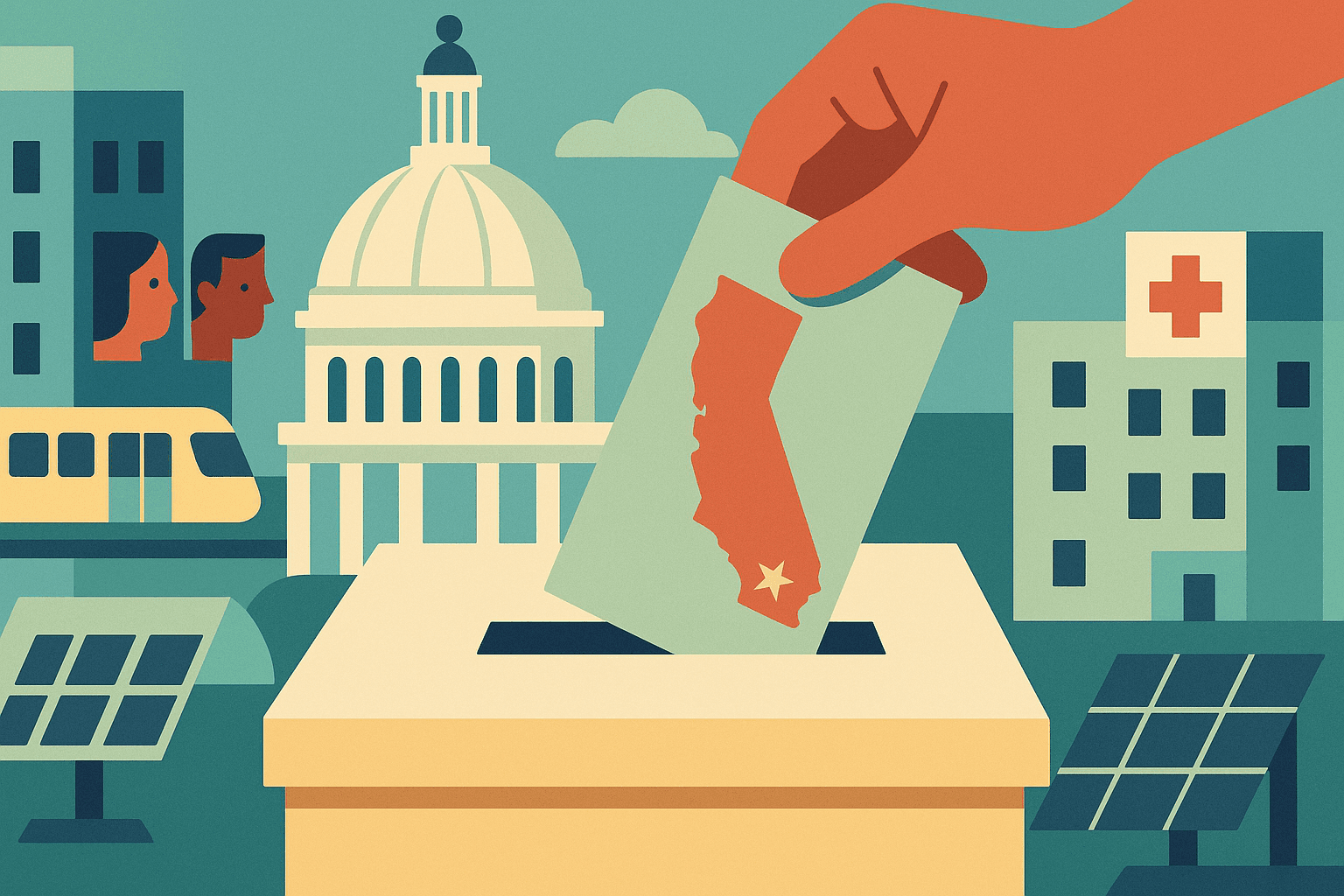
California's November 2026 ballot now has 14 statewide measures. Here's a quick rundown of what each one does.
The Facts
You'll be voting on 14 state ballot measures this November, and here's a quick overview of what each will do. GrowSF will publish detailed analyses of each one in the coming months.
- Prop 1: $11.25 billion in bonds: $10 billion for affordable housing construction, preservation, and homeownership programs, plus $1.25 billion for CalVet home loans that veteran borrowers repay themselves. The $10 billion refills existing programs whose 2018 bond money is spent, costs roughly $17.39 billion to repay over 30 years per a legislative analysis, and February PPIC polling found likely voters split at 49% yes.
- Prop 2: Doubles the state rainy day fund maximum from 10% to 20% of General Fund, forces bigger deposits in capital-gains boom years, extends mandatory debt paydown through 2039-40, and exempts reserve deposits from the Gann spending limit until withdrawn. Legislative Democrats put it on the ballot as part of the 2026 budget deal after years of surplus-then-deficit whiplash, and the nonpartisan LAO says it would cover about half of future shortfalls versus one-third under current rules, short of the 50% cap the LAO recommended.
- Prop 3: Makes the existing 10.3–12.3% top income tax rates permanent by deleting their 2030 expiration date; doesn't raise rates or create new taxes. The rates were created by Prop 30 (2012) and extended by Prop 55 (2016), bring in $5–15 billion a year, and while the money is branded for schools and children's healthcare, only about 40% typically reaches K-14 education, with the rest flowing to reserves and the general fund.
- Prop 4: Un-bans public financing for political campaigns by repealing California's 1988 ban. Charter cities like SF and LA already run such programs, since Charter cities are special.
- Prop 5: Ends the two-question recall ballot for state officers. Rather than a recall vote and a replacement vote, voters would decide only yes-or-no on removal, and a recalled Governor would be succeeded by the Lieutenant Governor. It would also newly allow a recalled officer to run in that later special election, and it passes with a simple majority.
- Prop 37: $25 billion in bonds to fund fixed-rate second mortgages covering up to 17% of the price of a newly built home, for buyers earning up to 200% of area median income who put at least 3% down. The bonds are repaid by borrowers rather than taxpayers (the LAO estimates no direct state or local costs), the program applies only to new construction to push supply rather than bid up existing homes, and the measure also bundles in an opt-in builder track trading stronger labor enforcement for friendlier construction-defect rules.
- Prop 38: $8.4 billion in general obligation bonds for immunology and immunotherapy research, splitting the proceeds evenly between one UC-affiliated institute and competitive grants, with $4.2 billion earmarked for cancer, heart disease, and Alzheimer's. It follows the Prop 71/Prop 14 stem cell bond model, would cost the General Fund roughly $500 million a year for about 25 years per the LAO, and is bankrolled by billionaire Dr. Gary Michelson, with the institute criteria closely matching UCLA's existing immunology institute.
- Prop 39: Requires photo ID for in-person voting, an ID number on mail ballots, and citizenship verification for registration. Nearly all Californians vote by mail, so for most voters the practical change is writing a driver's license or last-four digits of their Social Security number on the return envelope; the LAO pegs costs in the tens of millions annually, and the citizenship-check provision faces likely federal preemption litigation under the National Voter Registration Act.
- Prop 40: Imposes a one-time 5% tax on the wealth of Californians worth over $1 billion, sending 90% of the money to health care and 10% to schools and food assistance. It was put on the ballot by the SEIU healthcare workers union to offset federal Medicaid cuts, and it shares the ballot with two billionaire-funded countermeasures (Props 41 and 42) that can nullify it if they get more yes votes, so the margins matter as much as passage.
- Prop 41: Requires audits of programs funded by new special taxes proposed in an upcoming election, every four years after it passes, and blocks new taxes from Gann spending limit exemption. This is one of two anti-Prop-40 measures; with the Gann spending limit change being the operative provision that would block the "billionaire tax."
- Prop 42: Constitutional amendment to prevent future asset and wealth taxes, and most retroactive taxes. Another anti-Prop-40 measure, both main provisions are designed to block the billionaire wealth tax.
- Prop 43: Requires two-thirds voter approval for all local special taxes, including those placed on the ballot by citizen initiative. It was placed on the ballot by a near-unanimous Legislature as a deal to get the Howard Jarvis Taxpayers Association to withdraw a broader initiative that would have also capped transfer taxes and repealed existing ones like LA's Measure ULA; Prop 43 leaves existing taxes untouched and only applies going forward. It closes a court-created loophole that allowed local special taxes to pass with only a simple majority if they were put on the ballot via signatures rather than via legislation.
- Prop 44: Requires nonprofit community health clinics to spend at least 90% of annual revenue on direct patient care and mission-related expenses, with Attorney General enforcement, penalties, and refunds for money spent elsewhere. It was placed on the November 2026 ballot by SEIU-UHW after a similar bill (AB 1113) died in the Legislature, clinics are challenging it in federal court as preempted by federal health-center law, and much depends on how "mission-related expenses" gets defined in rulemaking.
- Prop 45: Fast-tracks "essential projects" (housing, water, clean energy, medical, public safety, broadband, education, and transportation) through CEQA reviews, with shorter agency deadlines and narrower judicial review. It builds on the Legislature's 2025 CEQA reforms (AB 130/SB 131) but goes further by locking streamlining into voter-approved law, and it drew over $13.7 million in supporter funding with no organized opposition committee reported as of the March 31, 2026 filings.
The Context
Hey, at least there's no dialysis measure.
The GrowSF Take
We've got our work cut out for us!
Sign up for the GrowSF Report
Our weekly roundup of news & Insights
Our weekly newsletter is a roundup of news and insights from GrowSF. Sign up to stay informed about the latest developments in San Francisco politics and policy.